While NexStorm includes support for self-made background maps in Windows BMP format, most users opt to obtain a Composite Vector Map, or CVM for short.
What is a vector?
A vector is essentially a pair of X/Y coordinates and a vector map is a collection of coordinates that describe different shapes such as roads, country borders, coastlines or lakes. By using vector graphics a map can be scaled to virtually any size without image quality loss. This is in contrast to raster based images (such as the Windows BMP bitmap) which are composed of pixels. Zooming in on a raster image will cause the pixels to become larger, creating so called pixelation artefacts which gets worse as the zoom increases.
A vector map, on the other hand, is redrawn when zoom is changed which means that there is no graphics quality loss whatsoever
Vector maps are extensively used in professional GIS software (Geographic Information Systems). The Astrogenic CVM format was specifically designed for use in NexStorm and has been optimized to provide the best possible geographical resolution to graphics rendering performance ratio.
A single CVM file contains map data for all available NexStorm zoom levels, hence "Composite". You can change outline and fill colors of the included geographical features such as roads, lakes and borders.
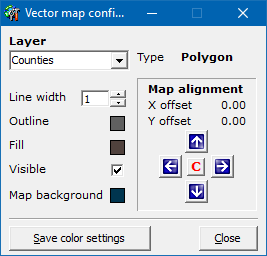 |
| Vector map configuration dialog |
⚡ Advantages ⚡
- A CVM map will save you a lot of time, headaches and frustration that comes with trying to make your own map. The CVM is custom made and projected for your latitude and longitude which means distance and angular errors are minimized
- With NexStorm and a CVM installed you can export the CVM map to PNG images. The exported images can then be used as background maps in other applications. NexStorm's Map snapshot feature can generate background map images of arbitrary dimensions. For each exported map image there is also an accompanying XML file which contains automatically computed geographical border coordinates. This supplementary data is often required by other geo-aware applications
 |
| Northern Europe at 1000km/750mi zoom level. Exported PNG image size 310x310 pixels |
 |
| Example of exported CVM geographical information in XML format |
- Bitmap map images created using NexStorm's Map snapshot feature is the recommended background map option for our StormVue GEN-3 web display application
- Using NexStorm's Place layer feature you can add own points of interest as an extra map layer. Populating your map with markers such as cities, airports and landmarks is easily done through a specially formatted flat text file which is loaded into NexStorm.
 |
| A custom place layer showing major cities at 500km/310mi zoom level |
- The place layer is zoom sensitive, meaning you can configure it to show increasingly more details as the map is zoomed in
 |
| Same place layer as in the image above but showing more details at 200km/124mi zoom level |
- The CVM format is fully display compatible with NexStorm Lite. The Place layer and Map snapshot features referred to on this page are software specific and not available in NexStorm Lite.
- Last but not least, it just looks great. Finding a suitable map or making your own with just the right amount of geographical details and correct scaling and map projection can be extremely difficult and time consuming. Geographical resolution in the CVM is optimized so that the important information - lightning activity - will not get lost due to an excessively cluttered map.
💳 Price: €50
Pay with PayPal by scanning the QR code on your phone, or click the Buy Now button.
Please prepare geographical location coordinates and location name. You will have to add this on the payment page. Omitting coordinates will delay your order. Provide coordinates in Degrees Decimal format to ensure fastest possible delivery.
Normal delivery time for this item is within 2 business days. The finished CVM file will be e-mailed to you as a ZIP file attachement.
📦 If you want to buy more than one product be sure to check out our bundles!